


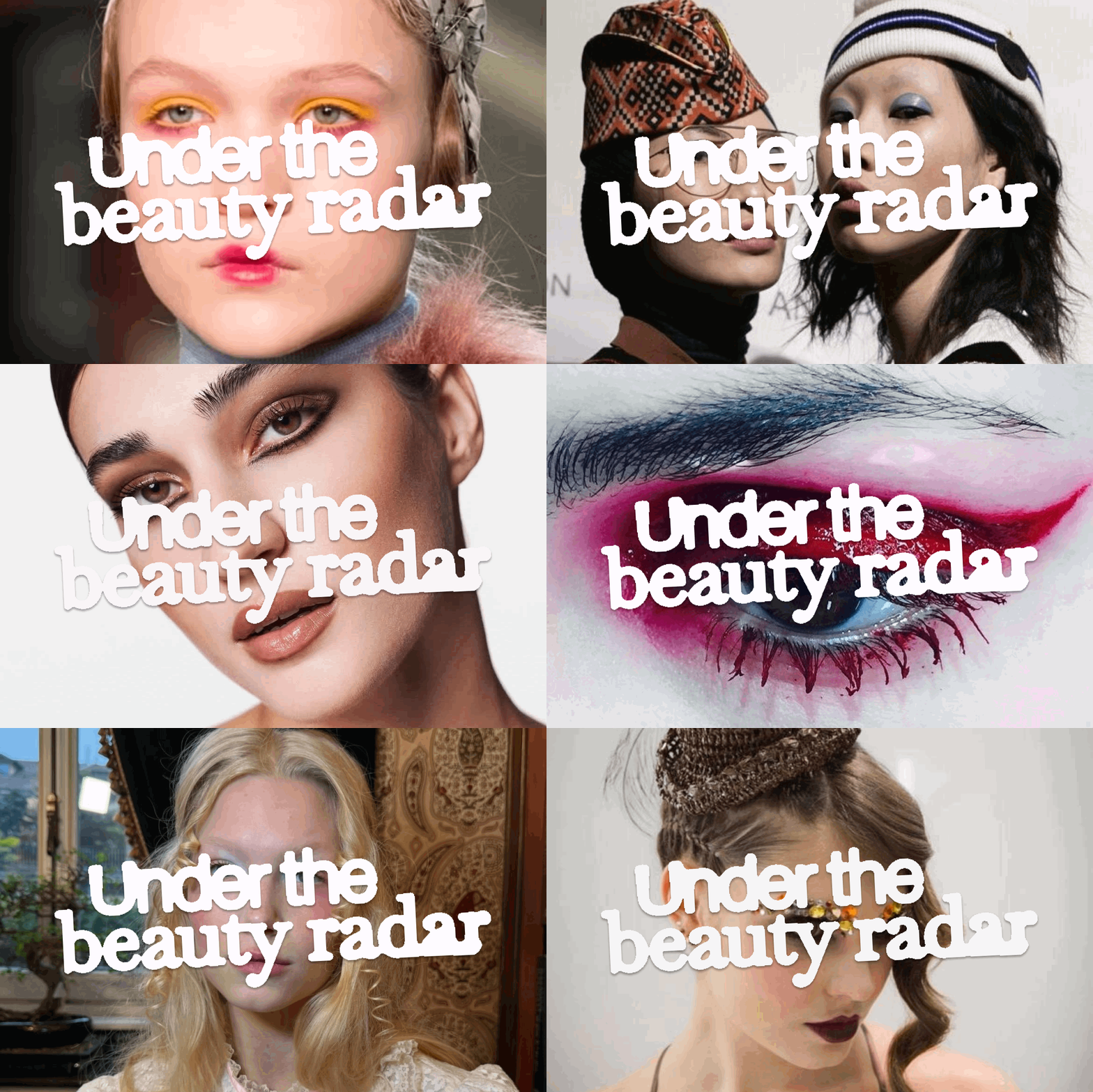
If, watching a fashion show, you have admired the consistency between clothes and make-up, between face and body. If you have thought that, in fact, the emotion that snakes on the catwalk can also be seen on the models’ faces - and whether they are made up in a fresh and natural way, colored or glow, dark and melancholic does not matter - then there is a high probability that you have had the privilege and pleasure of observing make-up looks created by Michele Magnani and his team. We ourselves met him backstage at Milan Fashion Week, always available to tell us everything, even in the chaos behind the scenes. For this reason, he seemed like an excellent candidate for Under the Beauty Radar, our column dedicated to professionals, especially those who travel under the radar… literally. This is what he told us.
Interview with Michele Magnani, Global Senior Artist for MAC Cosmetics
Introduce yourself to our audience
My name is Michele Magnani and I have been a make-up artist for over twenty-five years. Today I hold the role of Global Senior Artist for MAC Cosmetics. I started when this profession was very different from today: there were no social networks, there was no idea of the make-up artist as a character. There was only a desire to learn and to do their job well. Even the products available were not as many as they are now, and for this reason experimentation is part of my way of interpreting my profession. In recent years I have been lucky enough to work in more than 80 fashion weeks around the world, in the countryside, with photographers, designers, celebrities and to meet people from all over the world. But, if I have to be honest, what still excites me today is exactly the same thing that excited me on the first day: hitting the mark, seeing a person looking in the mirror and feeling good. Recognize yourself! Make-up is my language. It’s the way I found to tell emotions through texture and color, identity and character without the need for words.


How would you define your visual style in three words?
Authentic. Intentional. Emotional. I like that every choice has a meaning and to tell it. I don’t believe in makeup done just to amaze. Even the most creative look must express something about the person or story it wants to represent. The beauty that interests me is not the perfect one, but the one that, due to its simplicity or technique, leaves a mark on the memory and an emotion in those who look at it.
When did you realize that this would be your job?
I think I understood it long before I had the courage to admit it. As a child, I constantly drew faces, I watched my mom and sister wear makeup fascinated, I observed people, colors, light. I was curious how a detail could completely change an expression or an image. Then, after a few years as a freelancer, MAC came along and changed my life. It gave me a creative home, but above all it taught me that make-up could also be art, culture, freedom of expression and above all inclusion. From that moment on, I had no doubts.


You are the king of backstage fashion shows. What do you like best and what, on the other hand, do you not like about the backstage environment?
Backstage is the place where fashion is the truest. From the outside you can see the glamor. From the inside you can see the work, the effort, the respect for the times, the collaboration and that strong positive tension that is created a few minutes before a fashion show begins. It’s a perfectly organized chaos. What I love is just that energy. Very different people who, for a few hours, work with a single objective, on a shared project. There is no ego when time is running out: there is only teamwork. What I have the hardest time accepting is superficiality. When the ego takes over collaboration. Fashion may seem like a light world, but in reality it requires discipline, study and a lot of humility. When appearance is stronger than competence, it loses appeal.
You work with MAC Cosmetics. When was this synergy born and what does it mean for you to work with such an iconic brand?
I joined MAC in 2001, exactly 25 years ago and, looking back, I realize that it was not simply a job. It was where I grew up as an artist and primarily as a person. MAC has taught me not to be afraid of creativity, provocation or alternative makeup, but also to have enormous respect for those who sit in my chair. One thing I always say is that the products, on their own, don’t speak. Make-up artists are the ones who give them a voice. Through gesture, technique and interpretation, taking care of ourselves, we transform a lipstick, eye shadow or foundation into an emotion. And that’s what continues to fascinate me.


Tell us how a fashion show look was created, from the creative director’s idea to its creation
It all starts with a conversation (test day). The creative director recounts an emotion before even talking about make-up. It can be a woman who just came out of the sea, a party at 5 in the morning, a childhood memory, a movie, a painting or simply a feeling. Our job is to translate that vision into something that can live on a face. From there, a continuous dialogue began with hairstylist, stylist, casting director and photographer. You do tests, you change your mind, you remove elements, you add details. The hardest thing is to find the point where make-up stops being the protagonist and becomes an integral part of the story. When it happens, the look really works.
What do you get your inspiration from?
From life. From trips, from museums, from photography, from cinema, from architecture, but above all from people. I like to watch how they move, how they talk, what they wear, even how they fix their hair. I believe that creativity stems from attention and from the desire to understand others. The more you observe the world with all its differences with curiosity, the more you have something to tell.


How do you relate to trends? Do you follow them or do you try to create them?
Trends are a photograph of the present. I like to study them because they tell the historical moment we are living in, but I don’t think it’s our job to follow them. I prefer to interpret them or anticipate them. The difference between a trend and a style is that the former passes, while the latter continues to talk about you even when fashion changes.
What’s in your future?
I hope I never lose my curiosity. The thirst to know. I would like to continue working in fashion, create new projects, talk about make-up also through training and help new generations of artists to find their voice. If there’s one thing I’ve learned over the years, it’s that success doesn’t match a goal. It coincides with the possibility of continuing to get excited. And that is what I hope for the coming years.